Showing posts with label 5: Design for learning. Show all posts

Wednesday, 9 September 2026

Year Six Pekapeka Weeks 8 & 10


Today Year Six started a new mystery topic.  We learnt that when scientists classify animals it is called taxonomy. We began by sutdying the similarities between a mystery skeleton and a human skeleton.

Did you know that all animals can be seperated into two groups - vertebrates and invertebrates?

We could see a backbone so the mystery animals was a vertebrate.


We discovered the mystery skeleton was a bat.  We're going to study them because Peter and Zahara from Pestfree Howick said they live close by. We want to know how to protect this unique species.

"A species is a group of organisms that can reproduce and have off spring that can reproduce" Richie

What did we find out?

"Bats are the only mamals that can fly" Lose

"They use echo location to hunt" Aelene - we played a game to show how this works.

"Bats have similar bones to humans" Jason

Paris "All species have latin names."


What do we want to find out?


"Bats aren't blind.  They have good eye sight" Mila

Luca "When did people first discover them?"

"Has anyone eaten them?" Salar

"How long have they existed?"Mila

Maya "What is their life span?"

"Where they here before people?" Emma

"What do they eat?" Alysia

"Do they bite?" Lacey

"How do they mate?" Caleb


Pekapeka continued 24/09/26

Today Year 6 learnt that classification keys include extinct species like the NZ's Greater Short Tailed Bat.

We learnt more about our native bats by watching a video and reading a school journal.

Then it was time to take action.

What actions can we take to protect pekapeka?

Touma "Stop cutting down dead trees because the pekapeka live there."

"Set traps for pests that harm pekapeka" Nicolas

"Have pest free islands" Mila

"Put out auto resetting traps" Richie

Each class set a trap in the Mara Kai and then picked a cabbage to eat fresh from the garden.

Lastly we completed a batty crossword.


Tuesday, 8 September 2026

Year Three Investigate our Changing Mara

Today, Year Three talked about our changing garden now that takarua has turned to koanga. We wondered what happened to all the leaves that fell off the trees ...

“They blew away” Milan
“They went into the environment” Abby
Rhyden "The snow picked them up"
Zoey "I think that the wind blows them away and takes them to a forest"
Ibrahim "When it was autumn there was no sun just water and soil not the sun, so the leaves fell down and they die"


We took part in a Mystery Science lesson and created a paper model to investigate how the leaves seem to disappear over time.

What did we discover?

Colt "Fungus and worms and bacteria are super heroes"

"The animals broke up the leaves and the worms, bacteria and fungi ate them"

Next time we are going to learn about how scientists put animals into groups.


Tuesday, 25 August 2026

Year 4 Aihe Mathematicians

 Today Year 4 are taking a mathematical look at dolphins/aihe.


What do we already know about our Hauraki Gulf neighbours the dolphins?

"They have a hole to breathe and they can jump high" Valentin

"They breathe air but they have to stay in water" David

Joshua "They use echo location"

Lucy "They communicate with whistles and clicks."

Hirva "There's lots of different types of dolphins."

Logan "Their forehead is called melon."
"They are a type of whale" Logan R

"A group is called a pod." Archer


We watched a video of dolphins in our Gulf. 


What did we learn?

"A dolphin group is called a pod" Roy

Edison "The Maui dolphin is one of the smallest in the world"

Ken "The Maui dolphin was named the Maori God Maui"


Next we got into groups and ordered different types of dolphins from biggest to smallest based on our prior knowledge.  Then we check against information. Afterwards we went outside and estimated how big the dolphins were, then we measured exactly.

Next, we drew a dolphin in our book and added facts we had learnt.  Lastly, we had just enough time to review with a Kahoot


Please pack a litter free lunch to help protect our dolphins.

Tuesday, 24 March 2026

Year Three Kai Inquiry


 Today Year Three began their inquiry into kai by talking about what we had for breakfast in a sharing cricle.  There was lots of fruits, breads, porridge, cereals, eggs, and milk.


Next we used kai cards in groups to talk about our experiences with different kai and how we can group food. Some groups used colour to categorise while others used sizes, how they are eaten and one group even put them in alphabetical order. We shared our experiences of different foods like taro, tofu and dahl.


Afterwards it was time to go on a kai hunt to see all the food we grow at school with our very own compost.  We spotted kumara, slilverbeet, feijoas, strawberres, quince and apples.  We picked the apples and feijoas to try later.


Back in the classroom we designed a cut and paste menu,  We were careful to select at least five fruits and vegetables and a variety of different colours and types of food.


The apples and feijoas were DELICIOUS.  Next time we are looking forward to finding out about the journey our kai can take.


Wednesday, 27 August 2025

Year Five - Our Final Ready Steady Go Session


Today we were greeted at the school gate by the Travelwise team and a ZEBRA.  They were congratulating the tamariki using active travel.  Great timing for our last Ready Steady Go session.

We began by reviewing everything we've learnt about getting to school in a safe, healthy and environmentally friendly way, with a summative quiz, in our online workbooks.

Then we brainstormed the key ideas and words. We used these to create a catchy song to promote active travel with AI on Suno.

Listen to some of our tunes here:

Grace's Reggae Song

Angela's Walk to School Jam

Warren and Donglar's Rock Song

Renee's song

Emily's Anthem

Aelene's Catchy Tune

Alysia Sunnyhills Stroll

Emersyn's Song

Tuesday, 26 August 2025

Year Three Follow the Carbon Cycle


 Today Year Three investigated how we can be sustainable with our food waste.  Making sure no nutrients are lost, so we can keep growing new food and trees that give us oxegen and so that no parts of the world become a toxic dump.

We watched this video describing how Sunnyhills is sustainable with our scraps and talked about how we can do this at home with our own compost or the green lid bin.


Next we ate tangelos from Mrs Daniel's tree. "They taste zingy" said Joshua. "That tasted juicy" added Bella.

We collected the scraps and put them in our hot composters so the FBI (fungus, bateria and invertebrates) can break them down into new soil.


Next we each collected some "cooked" compost and put it on the Mara Kai ready for our spring planting. The compost was full of life! So many invertebrates! 

Room 18 found some pumpkin seeds in the compost that had germinated.  We potted them up in some soil to see if we can grow some delicious pumpkins to eat.  Free food!


Lastly, we recorded the carbon cycle in a diagram in our books: grow food - eat food - put scraps in compost - put compost on gardens and repeat.


Next time we're looking forward to investigating the invertebrates we saw,


Tuesday, 19 August 2025

Year Four - Aihe Investigation

 Today Year 4 are taking a mathematical look at dolphins/aihe.


What do we already know about our Hauraki Gulf neighbours the dolphins?

James "They use clicks and whistles to communicate"

Chase "They are mammals"

Ariella "The Chinese River Dolphin went extinct because of pollution"

"Spinner dolphins talk with types of splashes" Rigo

Curtis "Dolphins are clever"


We watched a video of dolphins in our Gulf. 

What did we learn?

Awa "Maui dolphin are the most endangered"

Payton "A group of dolphins is a called a pod"

Alonso "Bottle nosed dolphins so all the tricks"

Luke "Maui and Hector look the same but they are different species"

TJ "Maui is the smallest dolphin"

"Maui's dolphin is named after Maui because it only lives where Maui cast his hook" Allan


Next we got into groups and ordered different types of dolphins from biggest to smallest based on our prior knowledge.  Then we check against information. Afterwards we went outside and estimated how big the dolphins were, then we measured exactly.

Lastly we drew a dolphin in our book and added facts we had learnt.  Pack a litter free lunch to help protect our dolphins.

Tuesday, 12 August 2025

Year Three - Dirt Made My Lunch


Year Three are learning about the FBI - fungus, bacteria and invertabrates.  Our super hero clean up crew.

What is fungus? 

Aiden "Mushrooms are fungus"

Vincent "Like mushrooms that grow on things like old wood and rotten things in the ground"

Edison "They spread nutrients to the trees"

What is bacteria?

Amelia "Some bacteria is not bad"

"Bacteria can easily spread"

What are invertebrates? 

Don't have a back bone.

Kaylee "Like a crab"

Ananya "A snail"

Aila "A worm"

We saw the FBI breaking down food.  GROSS! So why are they so important? They break down dead things and return the nutirents into the soil.  Without them we would have no kai!


How did dirt/soil make our lunch?

Koen "My potato chips are from the ground because potatoes grow in the ground"

Today Year 3 learnt about the FBI - fungus, bacteria and invertaebrates.  We watched them break down fruit.  GROSS. So why are they so important to life on earth?

Brylee "They help plants grow because they eat the dead stuff and make it into soil so plants can grow"

And alllll our food come from plants grown in good soil.

We investigated our lunchboxes to see how all our kai came from the soil.

Chace " My chocolate cookie is from the ground because the cocoa beans grow in the ground and the flour is from wheat that grows in the ground"

Lucas "The sugar is from sugar cane that grows in the ground"

"Pepper comes from the soil becasue it's peppercorns"

"My oranges are from soil" David


Even things we thought were not from the ground like Yukult we realised still needs nutrient rich soil as it's made from milk from cows and cows eat grass that grows in the ground. We thought about honey too ...bees drink nectar from flowers that have grown in the ground.

We went to the school composters to see the FBI at work. Then we picked an ate a cabbage grown with the soil we made from food scraps. Yum. Thanks fungus, bacteria and invertebrates. 


Next time we're going to feed our Mara Kai with compost ready for spring planting. 


Tuesday, 24 June 2025

Year Four Master Navigators

 Today Year 4 continued our moana studies, and learnt about the important role of ocean voyages to our island nation. 

We 'Got Thinking' by listing all the vessels we knew in five minutes. Some of our ideas included sailing boat, waka, cruise ship, ferry and ship and jet ski.

We 'Explored' our ocean history by watching this: 


What was the video about?
Awa "The first oldest sailing cup is the America's Cup"
Payton "Kupe sailed across the Pacific Ocean to find Aotearoa and Captain Cook followed"
Luke "Kupe found Rarotonga first"


 And reading this Hui Te Rangiora: The Navigator

What did we learn?

Isabella "He may have sailed all the way to Antartica"

Ariella "Hui Te Rangiora was a master voyager"

Briar "When he was sailing he went past the top of NZ and all the way to Antartica."

Liam "The marae statues remind us of the navigation guy"

Chase "Hui Te Rangiora followed a route from Rarotonga to the east of Aotearoa"

Madeleine "You had to be a master navigator to sail to Aotearoa"


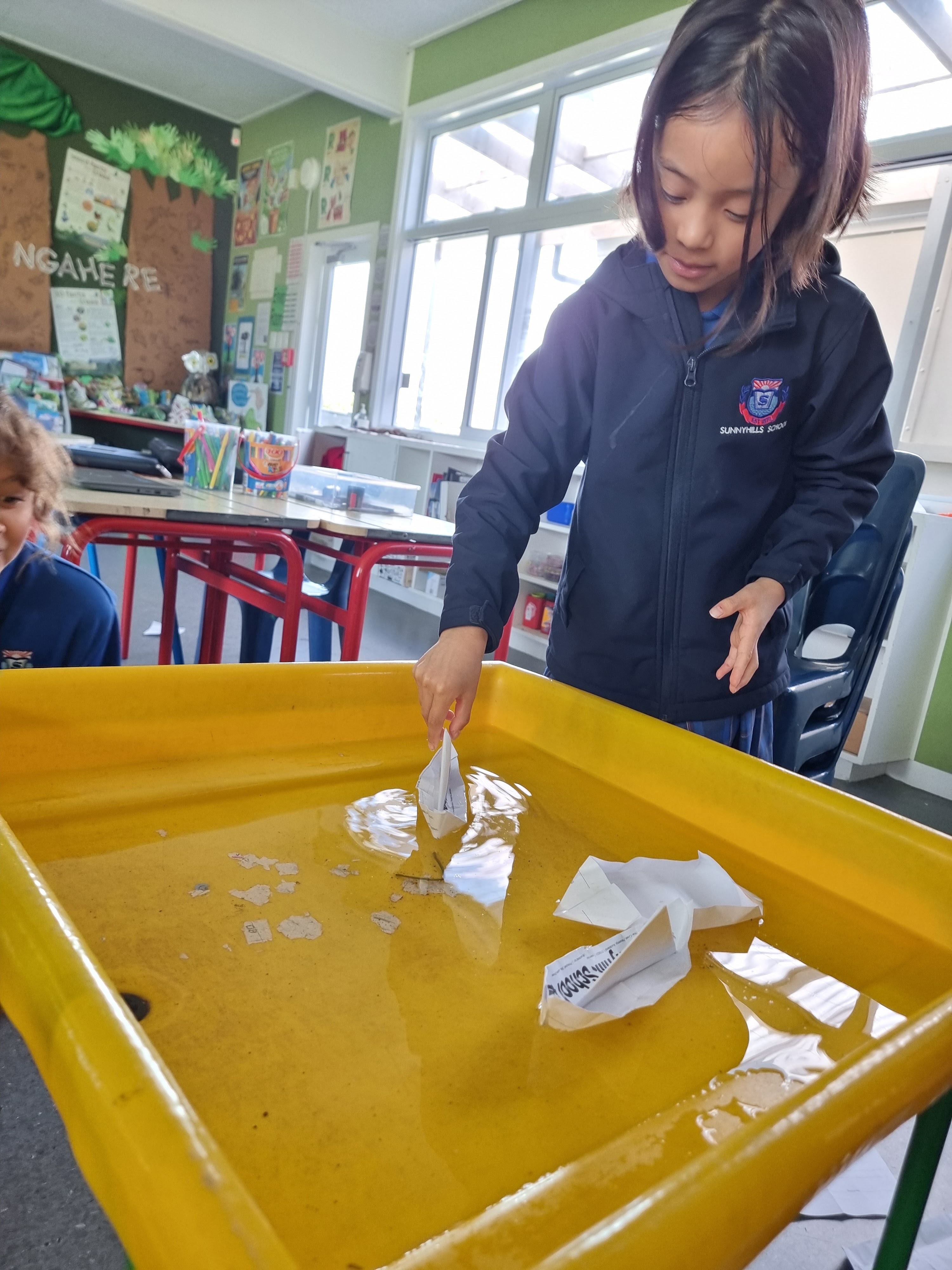
Next, we 'Made Meaning and Connections' by using A4 pieces of paper to design and build our own waka.  We "Shared & Shined" by testing our boats to see if they floated and making improvements.

Lastly we took action for the ocean by going on a litter hunt.  Sadly most of the litter was plastic and most of it had escaped lunch boxes.  Thank you to the families making the extra effort to pack a litter free lunch!